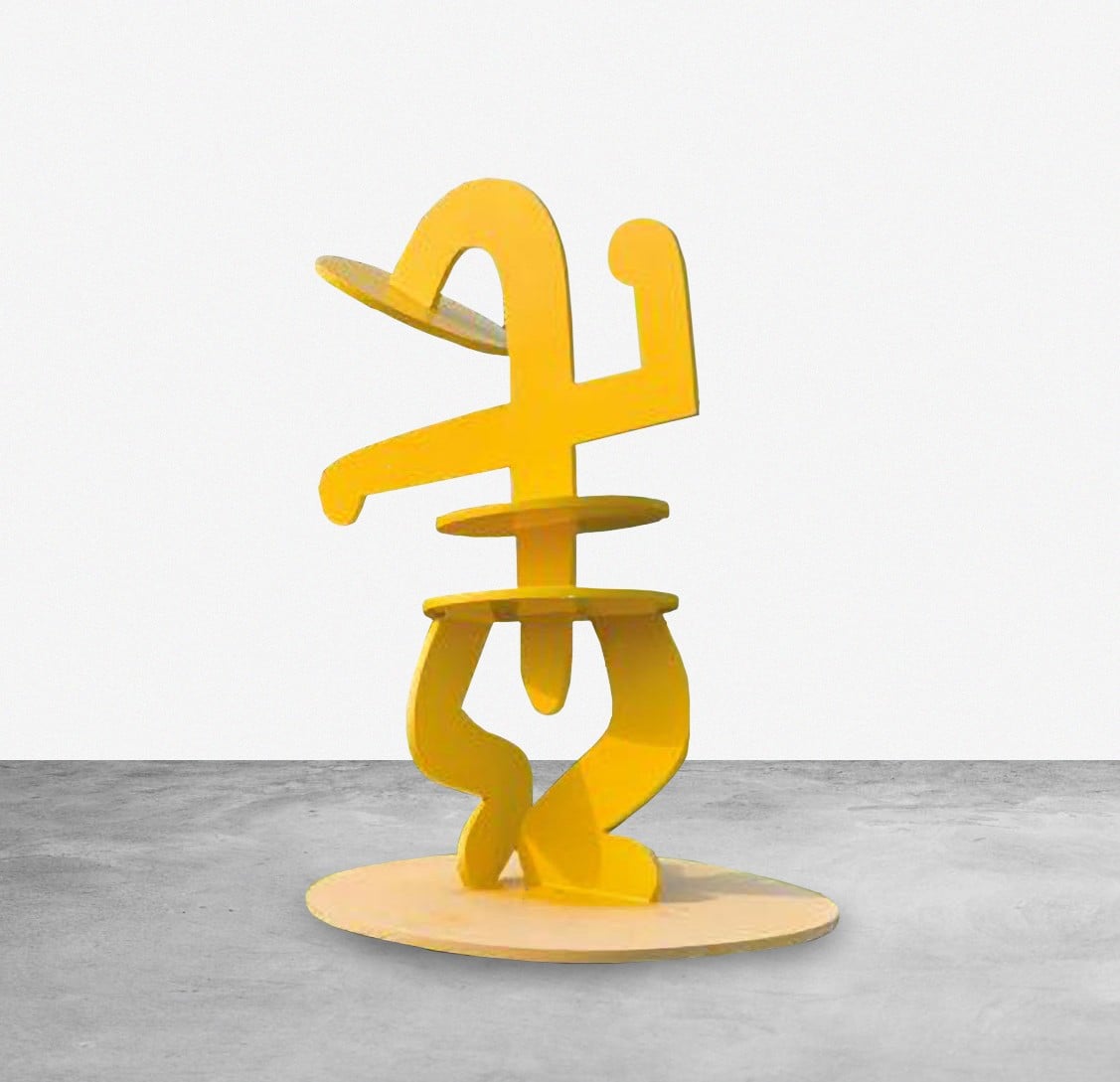
Keith Haring, Julia, 1987
04 November 2026
Keith Haring created Julia at a time when the graphic language he had developed through his celebrated New York subway drawings was increasingly translated into murals, objects, and sculpture. Haring began producing freestanding painted-metal sculptures in the mid-1980s, converting the thick contours of his drawings into cut metal planes assembled in three dimensions.[1] Julia does not belong to a formally titled series, but forms part of this concentrated sculptural practice, which extended Haring’s commitment to direct, publicly accessible imagery beyond the drawn surface.[2]
At over three-and-a-half metres high, the present version of Julia transforms a seemingly spontaneous figure into a monumental physical presence. A circular, tilted head crowns a dramatically elongated body, while projecting arms and horizontal planes establish a precarious sense of balance. Viewed frontally, the sculpture retains the immediacy of Haring’s linear silhouettes; moving around it reveals how those apparently simple shapes intersect and extend through space. The brilliant yellow enamel further suppresses surface detail in favour of an instantly legible form. Significantly, Julia is identified by Frederik Meijer Gardens & Sculpture Park as the only portrait sculpture Haring created. Its subject was his close friend and studio manager Julia Gruen, who later became a leading figure at the Keith Haring Foundation.[3]
Yet Haring rejects conventional portrait likeness. Identity is instead conveyed through gesture, rhythm and bodily movement. This approach connects Julia closely to the artist’s longstanding engagement with dance. Art historian Robert Farris Thompson observed that Haring translated the movements of electric boogie and breakdancing into his pictorial vocabulary; Haring himself recalled incorporating poses he had observed among dancers directly into his images.[4] The sculpture’s bent lower body, extended limbs and tilted head similarly suggest a figure caught in motion rather than immobilised by the sculptural medium.
This emphasis on accessibility also places Julia firmly within Haring’s broader conception of public art, a central aspect of his practice examined in recent scholarship.[5] An edition of Julia was included in the Public Art Fund’s 1997 ‘Keith Haring on Park Avenue’, the first comprehensive survey of his monumental sculptures from 1985–89.[6] The National Gallery of Canada, which holds another Julia[7] alongside Untitled (Figure on Baby)[8] and Untitled (Ringed Figure)[9], has described these painted aluminium sculptures as deliberately bright, stable and inviting works intended for public settings.[10] Julia therefore unites the intimacy of a portrait of a friend and his ambition to create images capable of communicating immediately within shared public space.
[1] Richard D. Marshall, (2005), “Keith Haring, Sculpture”, Lever House Art Collection, Available from: https://www.leverhouseartcollection.com/commissions/keith-harring [Accessed 16 September 2026]
[2] Dieter Buchhart, ed., (2014), Keith Haring: The Political Line, San Francisco: Fine Arts Museums of San Francisco; New York: DelMonico Books
[3] Frederik Meijer Gardens & Sculpture Park, (n.d.), Keith Haring: Julia, Available from: https://www.meijergardens.org/sculpture/keith-haring/ [Accessed 16 September 2026]
[4] Robert Farris Thompson, (1990), “Requiem for the Degas of the B-boys, Keith Haring”, Artforum, May, Vol. 28 No. 9, Available from: https://www.artforum.com/features/requiem-for-the-degas-of-the-b-boys-keith-haring-204839/ [Accessed 16 September 2026]
[5] Sarah Loyer, ed., (2023), Keith Haring: Art Is for Everybody, Los Angeles: The Broad; New York: DelMonico Books
[6] Keith Haring, (1997), ‘Keith Haring on Park Avenue’, New York: Public Art Fund, 16 June–10 October
[7] Keith Haring, (1987), Julia, aluminum with polyurethane enamel, 245.5 x 212 x 147 cm, Ottawa: National Gallery of Canada, 40104
[8] Keith Haring, (1987), Untitled (Figure on Baby), aluminum with polyurethane enamel, 267 x 191.2 x 124 cm, Ottawa: National Gallery of Canada, 40103
[9] Keith Haring, (1987), Untitled (Ringed Figure), aluminum with polyurethane enamel, 243.5 x 190 x 124.5 cm, Ottawa: National Gallery of Canada, 40105
[10] National Gallery of Canada, (2000), Annual Report 1999–2000, Ottawa: National Gallery of Canada